

Losing Your Job Was Bad Enough. Now What About That 401(k) Loan?
Losing your job can turn your finances upside down, especially when you've borrowed money from your 401(k). Suddenly, that manageable loan could become a tax headache. The good news? You might have more options than you realize, provided you understand the rules and act before certain deadlines.
Why Borrowing From Your 401(k) Seemed Like A Good Idea
When you needed extra money, borrowing from your retirement savings probably sounded sensible. You weren't applying for a traditional bank loan, and the interest payments went back into your retirement account. Better still, a properly structured 401(k) loan generally doesn't trigger income taxes when you receive the money.

How A 401(k) Loan Actually Works
Most qualifying 401(k) loans allow you to borrow up to 50% of your vested account balance, with a maximum of $50,000. Certain exceptions and adjustments apply. You generally have five years to repay the money, although loans used to purchase a primary residence can qualify for longer repayment periods.

Everything Was Fine Until You Lost Your Job
While you were employed, loan payments may have come directly out of your paycheck. Then came the layoff, and those automatic deductions stopped. Unfortunately, your loan didn't disappear along with your job. What happens next depends largely on your former employer's retirement plan rules.

Your Employer Might Want The Money Back
Here's where things become uncomfortable. Some 401(k) plans require departing employees to repay their outstanding loans in full. Others allow former employees to continue making scheduled payments. There isn't one universal repayment policy, so checking your specific plan documents should be your first priority.

You Might Be Able To Keep Making Payments
Not every job loss results in an immediate loan default. Some retirement plans permit former employees to continue repaying their loans through bank transfers or other payment arrangements. If your plan allows this, maintaining those payments could prevent the outstanding balance from becoming taxable.

But What Happens If You Can't Repay It?
Suppose you owe $15,000 on your 401(k) loan and cannot meet your plan's repayment requirements. The IRS may treat that outstanding balance as a retirement plan distribution. Instead of owing money to your retirement account, you could suddenly owe income taxes on money you borrowed months or years earlier.
 Miro Vrlik Photography, Shutterstock
Why The IRS Suddenly Gets Involved
Ordinary 401(k) loans aren't taxable because you're expected to repay them. But when a loan defaults or your plan uses retirement savings to settle the balance, the tax treatment changes. Previously untaxed money can become taxable income, even though you aren't receiving another check.
 G. Edward Johnson, Wikimedia Commons
You Could Owe Ordinary Income Tax
For a traditional, pretax 401(k), a taxable unpaid loan balance generally gets added to your income for the year the distribution occurs. That means the money could be taxed at your applicable federal income tax rates. State income taxes may apply, too, depending on where you live.
 stevepb, CC0, Wikimedia Commons
Here's What A $15,000 Loan Could Cost
Imagine your remaining loan balance is $15,000 and the entire amount becomes taxable. If your marginal federal tax rate is 22%, that could mean approximately $3,300 in additional federal income taxes. That's before considering possible state taxes or an early-distribution penalty. Your actual tax increase may differ.

There's Another Potentially Expensive Surprise
If you're younger than 59½, the IRS generally imposes an additional 10% tax on early retirement plan distributions unless an exception applies. On a taxable $15,000 loan balance, that's potentially another $1,500. Suddenly, the financial consequences of losing your job look considerably more expensive.

Your Total Federal Tax Hit Could Be Substantial
Using our example, $3,300 in federal income taxes plus a $1,500 early-distribution tax produces a potential $4,800 bill. That's nearly one-third of the unpaid loan balance. Remember, this is an illustration assuming a 22% marginal rate and no penalty exception, not a guaranteed tax calculation.
Being Unemployed Doesn't Automatically Eliminate The Penalty
You might reasonably assume that losing your job qualifies you for special tax treatment. Unfortunately, unemployment by itself doesn't exempt a 401(k) distribution from the additional 10% tax. However, certain circumstances, including your age when employment ended, can make a significant difference.

The Age 55 Rule Could Save You Money
Here's something worth knowing if you're approaching retirement. If you leave your employer during or after the calendar year you turn 55, qualifying distributions from that employer's 401(k) may escape the additional 10% tax. This exception doesn't eliminate ordinary income taxes, but it could substantially reduce your bill.

What If You're Already 59½ Or Older?
If you're at least 59½ when the taxable distribution occurs, the standard 10% early-distribution tax generally won't apply. You may still owe ordinary income taxes on the taxable balance, however. Reaching that age removes one potential expense, not necessarily the entire tax liability.

Not Every Unpaid Loan Gets Treated The Same Way
The IRS distinguishes between a deemed distribution and a plan loan offset. Although both can create taxable income, they have different consequences. Understanding which one applies is particularly important because it determines whether you might be able to avoid immediate taxes through a rollover.

What Exactly Is A Deemed Distribution?
A deemed distribution generally occurs when your loan violates repayment requirements, such as when payments stop and the permitted correction period expires. The IRS treats the outstanding amount as distributed for tax purposes. Unfortunately, a deemed distribution isn't eligible for rollover treatment, making it especially important to address missed payments early.

A Plan Loan Offset Is Different
A plan loan offset happens when your retirement plan actually reduces your account balance to settle the unpaid loan. Unlike a deemed distribution, this counts as an actual distribution that may qualify for rollover treatment. That difference can provide an opportunity to avoid immediate income taxes.

You May Have Until Tax Time To Fix Things
For a qualified plan loan offset caused by losing your job, the IRS provides an extended rollover deadline. Generally, you have until your federal income tax return's filing deadline, including extensions, for the year the offset occurs. That can provide considerably more breathing room than the usual 60-day rollover period.

Here's How That Deadline Might Work
Suppose your qualifying loan offset occurs in 2026. Your rollover deadline would generally be your 2026 federal income tax return deadline in 2027, including a valid filing extension. However, not every loan offset qualifies for this extended deadline, so confirm the transaction's classification before making plans.

There's One Big Catch With A Rollover
You can't simply transfer the unpaid loan balance into an IRA. To replace the offset amount, you generally need to contribute an equivalent amount of money from another source. If your outstanding loan is $15,000, you'll need $15,000 in available funds to complete a full rollover.

What If You Can Only Replace Part Of The Money?
Fortunately, an eligible loan offset doesn't always require an all-or-nothing decision. If you can replace only $5,000 of a $15,000 offset, you may be able to roll over that portion. The remaining $10,000 could still be taxable, with an additional early-distribution tax if applicable.

Don't Forget About Form 1099-R
If your loan becomes a reportable distribution, your retirement plan administrator generally issues Form 1099-R. This document reports information about the transaction to you and the IRS. Review it carefully, because different distribution codes can identify a deemed distribution, a qualified loan offset, or another type of transaction.
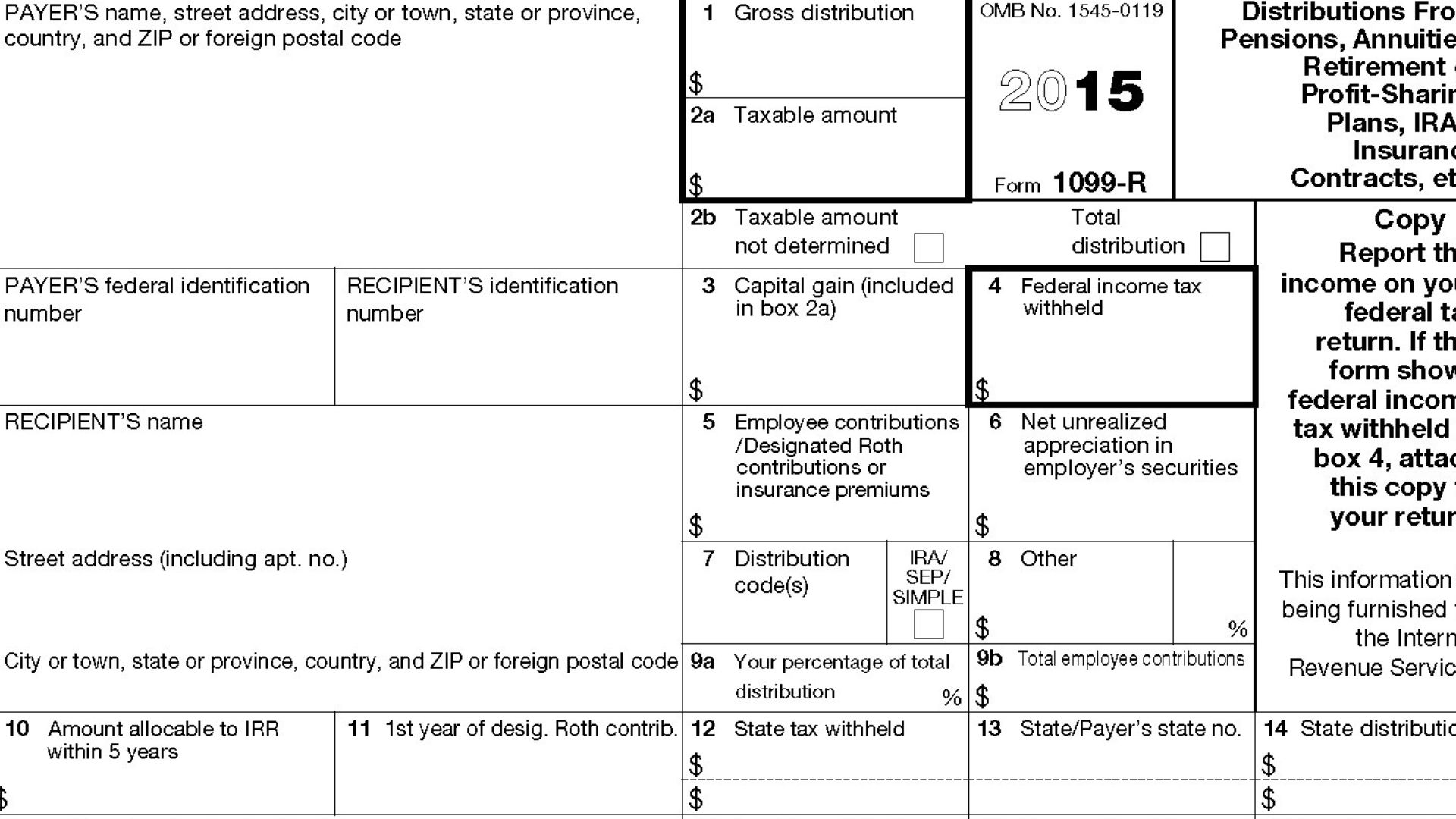 United States Internal Revenue Service, Wikimedia Commons
Will Taxes Automatically Be Taken Out?
Not necessarily. When a 401(k) loan becomes a taxable distribution without an accompanying cash payment, there may be no money available for withholding. That means you could receive a tax bill without having received additional cash. Depending on your circumstances, estimated tax payments may help prevent further penalties.

Your Retirement Savings Take A Hit, Too
The immediate tax consequences aren't the only concern. An unpaid loan settled against your retirement account also reduces the savings available for future investment growth. Depending on your age and retirement plans, replacing that missing money could prove harder than dealing with the immediate tax bill.
What Should You Do Immediately After Losing Your Job?
Start by contacting your former employer's plan administrator. Ask whether payments can continue, when the loan becomes delinquent, and whether an offset is planned. Request your outstanding balance and repayment terms in writing. Then speak with a qualified tax professional before making decisions about repayment or rollover options.

Losing Your Job Doesn't Have To Become A Retirement Tax Disaster
A job loss is stressful enough without discovering that your 401(k) loan might generate thousands in taxes. Fortunately, repayment arrangements, rollover opportunities, and certain penalty exceptions may help. The important thing is understanding your plan's rules, identifying the applicable deadlines, and taking action before your options disappear.

You May Also Like:
The History Of Postal Savings Accounts And Why The Federal Government Stopped Offering Them
How Credit Card Promotional Rates Can Turn A Deferred-Interest Purchase Into An Expensive Loan