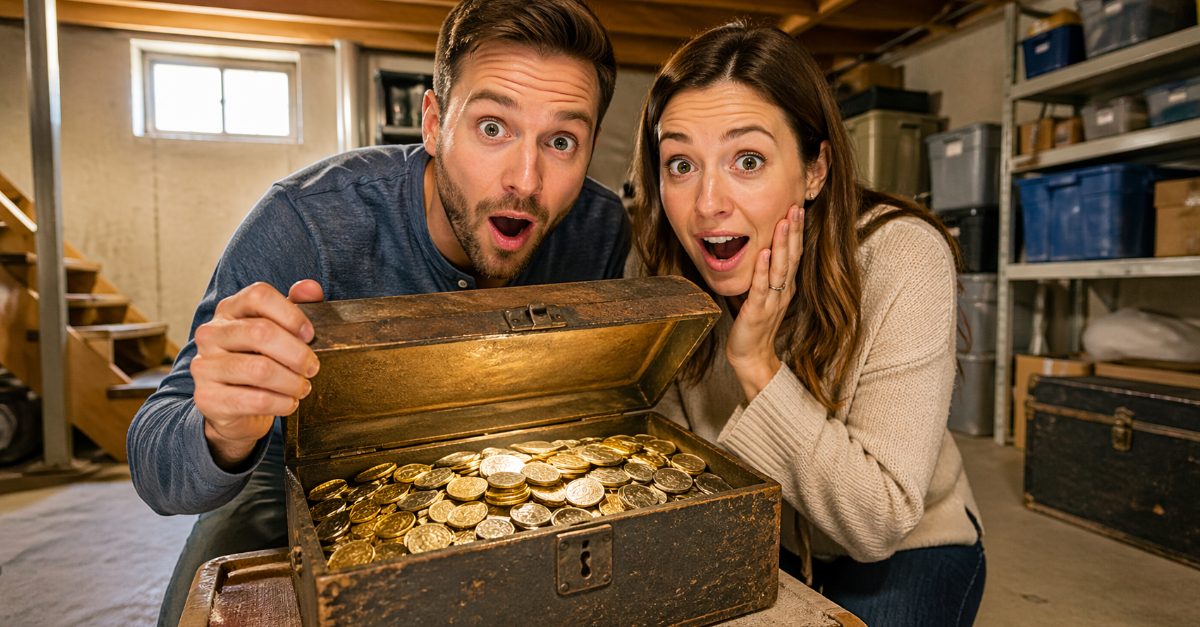
We found a box of valuable coins hidden in the basement of our new house—we moved in 6 months ago, so when do they legally become ours?

We found a box of valuable coins hidden in the basement of our new house—we moved in 6 months ago, so when do they legally become ours?


April 27, 2026 | Jesse Singer

We found a box of valuable coins hidden in the basement of our new house—we moved in 6 months ago, so when do they legally become ours?


A Hidden Surprise With Big Questions

Moving into a new home comes with all kinds of surprises—but finding a hidden box of valuable coins feels like a great one. However, despite what we all learned as kids on the playground, “finders keepers” doesn’t always apply. In reality, situations like this can quickly turn into legal gray areas.

Man and Woman and box of valuable coinsFactinate

Advertisement

It Happens More Often Than You’d Think

Hidden cash, coins, and valuables are discovered in U.S. homes more often than people realize: inside walls, under floorboards, and in basements. In several well-known cases, finds worth tens of thousands, or even more, ended up in court because ownership wasn’t clear.

assorted coin lotpina messina, Unsplash

Advertisement

Not All “Finds” Are Automatically Yours

Under U.S. law, finding something on your property does not automatically transfer ownership. Courts rely on established categories of found property to determine rights. In most cases, the finder only has possession—not full legal ownership—until those rules are applied.

architectural photography of trial court interior viewDavid Veksler, Unsplash

Advertisement

Lost vs. Mislaid vs. Abandoned

“Lost” property is unintentionally dropped. “Mislaid” property is intentionally placed and forgotten. “Abandoned” property is intentionally given up. Courts use these definitions to decide ownership, and small details about how something was left matter a lot.

Hands arranging a variety of international coins on a neutral light background.cottonbro studio, Pexels

Advertisement

Hidden Coins Are Rarely “Lost”

Coins hidden in a basement, wall, or container are almost never treated as lost property under U.S. law. Courts generally assume they were deliberately placed there for safekeeping, which shifts them into the “mislaid” or “treasure trove” category instead.

A child adds coins into a glass jar labeled for savings on a wooden floor.cottonbro studio, Pexels

Advertisement

Why “Mislaid” Changes Everything

If the coins are considered mislaid, courts often give the possessor of the place where they were found the right to hold them against everyone except the true owner. The reasoning is that the original owner is most likely to return to that location to reclaim them.

silver and gold round coinsImmo Wegmann, Unsplash

Advertisement

Could It Belong to the Previous Owner?

Possibly, but not automatically. Courts look at factors like where the coins were found, how they were hidden, and who had possession of the property. The prior homeowner, current homeowner, or even a third party could potentially have the stronger claim.

man in black suit jacket standing beside woman in white dress shirtNational Cancer Institute, Unsplash

Advertisement

What If the Previous Owner Never Mentioned It?

Not disclosing hidden valuables during a sale doesn’t automatically mean they gave them up. Courts typically require clear intent to abandon property, and simply leaving something behind, even for years, may not qualify as abandonment.

Woman in suit shows document to manVitaly Gariev, Unsplash

Advertisement

Your Purchase Agreement Matters

Your home purchase contract can influence the outcome. Most agreements transfer fixtures and visible contents, but rarely address hidden valuables unless specifically mentioned in the terms.

man writing on paperScott Graham, Unsplash

Advertisement

All Contents Clauses Can Be Limited

Even if your contract includes “all contents,” courts often interpret that as everyday items left behind, not concealed valuables. Hidden items are frequently treated separately in legal disputes.

person writing on white paperCytonn Photography, Unsplash

Advertisement

The Role of Treasure Trove Laws

Some jurisdictions recognize “treasure trove,” usually referring to hidden coins or valuables whose owner is unknown. Under traditional rules, the finder may have rights against everyone except the true owner—but states apply this concept differently today.

brown wooden tool on white surfaceTingey Injury Law Firm, Unsplash

Advertisement

A Real Court Case Shows How This Plays Out

In Benjamin v. Lindner Aviation (Iowa, 1995), workers found more than $18,000 hidden in an airplane wing. The court ruled it was mislaid property and awarded possession to the plane’s owner (not the finders) showing how often discovery alone isn’t enough.

Female judge in a courtroom setting, focusing on legal documents with a gavel.khezez | Khazaz, Pexels

Advertisement

Laws Vary by State

There is no single national rule that applies to found property. States interpret these situations differently, and court rulings can vary widely. In many cases, past legal decisions in your specific state will heavily influence the outcome.

a judge's gavel on top of a flagBermix Studio, Unsplash

Advertisement

A Quick Note for Canada

Canada uses similar categories: lost, mislaid, and abandoned—but laws are set at the provincial level rather than nationally. Provinces may apply different reporting requirements and ownership rules than U.S. states in similar situations.

shallow focus photo of Canada flagDillon Lobo, Unsplash

Advertisement

Time Alone Doesn’t Grant Ownership

There is no universal U.S. rule where ownership transfers after a set time like six months. In many jurisdictions, ownership depends on legal classification and whether required reporting and waiting periods are followed.

selective focus photo of brown and blue hourglass on stonesAron Visuals, Unsplash

Advertisement

You May Have a Duty to Report It

Many jurisdictions have laws requiring certain found property to be reported or turned over to authorities. If no one claims it within the required period, the finder may gain rights, but the process varies by state.

person holding pen and writing on paperLeon Seibert, Unsplash

Advertisement

What If No One Comes Forward?

If you properly report the find and no one claims it, some states allow the finder or property owner to eventually take legal ownership. However, this depends on following exact legal procedures, documentation requirements, and state-specific timelines.

Professional businessman in suit reviewing documents on clipboard at office desk.Alena Darmel, Pexels

Advertisement

Documentation Matters

You should carefully document when and where the coins were found, their estimated value, and any attempts to report them. This detailed record can be critical if ownership is later challenged, questioned, or disputed in court.

Professional man intently reviewing paperwork at his workstation indoors.Vanessa Garcia, Pexels

Advertisement

Selling Too Soon Can Backfire

If you sell the coins before ownership is legally clear, you could be forced to repay the full value if a rightful owner emerges. In some cases, that can lead to lawsuits, financial penalties, or even additional legal consequences.

Close-up of a person's hands holding loose change at a Prague market.Hana Mara, Pexels

Advertisement

Value Changes the Stakes

The higher the value, the more likely the situation will involve serious legal scrutiny. Rare or collectible coins may also require professional authentication and could trigger disputes from collectors, heirs, or previous owners.

A hand holding a variety of coins with more scattered on a white surface, symbolizing currency and finance.cottonbro studio, Pexels

Estate Claims Are Possible

If the previous owner has passed away, their estate—or heirs—may still have legal rights to the coins. These types of claims can surface years later, especially if the value of the find is significant.

Miniature wooden house with keys and contract symbolizing real estate transactions.Atlantic Ambience, Pexels

Advertisement

When in Doubt, Talk to a Lawyer

A real estate or property lawyer can review your contract and your specific state’s laws. Even a short consultation can clarify your rights and help you avoid potentially costly legal mistakes down the road.

Lawyer discussing legal documents with clients at office desk.Pavel Danilyuk, Pexels

Advertisement

It Feels Like a Jackpot—But It’s Complicated

While it feels like a lucky discovery at first, U.S. law prioritizes original ownership over simple possession. Many similar cases have ended with the finder losing the property after a lengthy and expensive legal challenge.

Patriotic scene with American flag and law book on a white background, symbolizing freedom and democracy.Tara Winstead, Pexels

Advertisement

So…When Do They Become Yours?

They usually become yours only after you follow required legal steps—such as reporting the find, waiting any required period, and confirming no valid ownership claims exist. Even then, the exact outcome depends on your state’s laws and classification.

Judge signing documents at desk with focus on gavel, representing law and justice.KATRIN BOLOVTSOVA, Pexels

Advertisement

The Bottom Line

Finding valuable coins doesn’t mean you own them. Before selling anything, make sure you’ve followed the legal process in your state—or you could risk losing both the coins and the money.

Crop anonymous person demonstrating heap of coins in hands demonstrating concept of savingsAtlantic Ambience, Pexels

Advertisement

You Might Also Like:

I got rid of my former tenant’s belongings months after she moved out. Now she’s back threatening to sue me for the value of the lost items. What now?

Are You Being Paid Enough? The “Living Wage” In Every State—And How Far The Median Income Really Falls Short

Sources:  123


READ MORE

I'm trying to sell my house but my neighbour never mows his lawn or cleans up his property, and it's affecting the value of my home. What can I do?

Curb appeal doesn’t stop at your property line, and unfortunately, your neighbor’s overgrown lawn or junk pile can absolutely hurt your sale price. But what can you do about it?
December 11, 2025 Jesse Singer
Credit Card

Ways to Improve Your Credit Score Fast

Stuck in a credit rut? A low credit score can feel like a roadblock but, hey, it’s not unsalvageable. There are things you can do that’ll boost your score and your confidence pronto.
December 20, 2024 Miles Brucker
Golf

11 Leisure Time Activities Of The World’s Richest People

Apart from business deals, bank accounts, and monitoring the stock market, some billionaires have hobbies that are surprisingly down-to-earth—or outright unexpected. So, what are the richest people’s favorite hobbies?
December 24, 2024 Peter Kinney

Surprising Things That Decrease Your Property Value

If you’re trying to sell your home, there are many things that can decrease your property value—but even the experts were surprised by potential buyers’ biggest turn-off.
December 4, 2025 JK

I bought a house with a shared fence. My neighbor doesn't take care of his side and now he wants me to pay for his upgrades. What are my options?

Buying a house with a shared fence might seem simple—it's just a fence what could go wrong? Well, it's all fun and games until your neighbor neglects their side and suddenly wants you to pay for upgrades.
December 19, 2025 Jesse Singer

Rare And Expensive Pokémon Cards Still Hiding In People's Closets

The world of Pokémon card collecting has grown from a childhood hobby into a high-stakes game for serious collectors, investors, and nostalgic fans alike. From one-of-a-kind tournament trophies to mysterious misprints and elusive promos, these cards are the crown jewels of the Pokémon Trading Card Game.
December 8, 2025 Quinn Mercer


Disclaimer

The information on MoneyMade.com is intended to support financial literacy and should not be considered tax or legal advice. It is not meant to serve as a forecast, research report, or investment recommendation, nor should it be taken as an offer or solicitation to buy or sell any securities or adopt any particular investment strategy. All financial, tax, and legal decisions should be made with the help of a qualified professional. We do not guarantee the accuracy, timeliness, or outcomes associated with the use of this content.


Dear reader,


It’s true what they say: money makes the world go round. In order to succeed in this life, you need to have a good grasp of key financial concepts. That’s where Moneymade comes in. Our mission is to provide you with the best financial advice and information to help you navigate this ever-changing world. Sometimes, generating wealth just requires common sense. Don’t max out your credit card if you can’t afford the interest payments. Don’t overspend on Christmas shopping. When ordering gifts on Amazon, make sure you factor in taxes and shipping costs. If you need a new car, consider a model that’s easy to repair instead of an expensive BMW or Mercedes. Sometimes you dream vacation to Hawaii or the Bahamas just isn’t in the budget, but there may be more affordable all-inclusive hotels if you know where to look.


Looking for a new home? Make sure you get a mortgage rate that works for you. That means understanding the difference between fixed and variable interest rates. Whether you’re looking to learn how to make money, save money, or invest your money, our well-researched and insightful content will set you on the path to financial success. Passionate about mortgage rates, real estate, investing, saving, or anything money-related? Looking to learn how to generate wealth? Improve your life today with Moneymade. If you have any feedback for the MoneyMade team, please reach out to [email protected]. Thanks for your help!


Warmest regards,

The Moneymade team